The Design Jobs That Are Actually Disappearing
And what that means for the rest of us
Nov 26, 2025
The Design Jobs That Are Actually Disappearing (And What That Means for the Rest of Us)
Last month, I was scrolling through TikTok when I came across a video from Expressen, one of Sweden's major newspapers. They were listing jobs that AI is "replacing" and one of them stopped me cold. Design and communication. The very work I've built my career around, the things I genuinely love doing, were on that list.
I sat there thinking about what that actually means. Not the headline version but the nuanced reality of what's happening in studios and agencies right now.
This isn't a hypothetical threat anymore. Jobs in design and communication are actually disappearing. Not all of them, not even most of them, but specific kinds of work are evaporating faster than anyone expected. And as someone who enjoys getting hands on, working creatively with design and UX and studied as a Interaction Design, I'm watching it happen in real-time.
But here's what I think is actually going on, and why I'm still optimistic about design careers despite everything.
Let's Be Honest About What's Already Gone
I need to be real with you about what's happening in our field. The junior designer who cranks out social media templates? That job is disappearing. The copywriter who writes standard product descriptions? AI does that now, faster and cheaper. The graphic designer who makes variations of existing brand assets? Midjourney and DALL-E are eating that for breakfast, lunch and dinner simultaneously.
The uncomfortable truth is that if your job is primarily execution of established patterns, you're competing with something that doesn't sleep, doesn't need benefits, and costs almost nothing. That's not a fair fight, and pretending otherwise doesn't help anyone.
The Work That's Actually Being Replaced
Let me get specific because vague warnings don't help anyone. Here are the roles I'm seeing actually contract or disappear in the design and communication space:
Production designers who take creative direction and execute it are finding their roles shrinking dramatically. AI can now take a mood board and art direction and generate dozens of variations. The person who spent their day making those variations is increasingly unnecessary. I know three designers personally who held these roles two years ago and are now retraining or have left the field.
Junior copywriters working on standard marketing content face brutal competition from AI. Writing product descriptions, basic blog posts, standard email campaigns. Don't get me wrong, this work still needs human oversight, but it doesn't need someone doing it full-time anymore or in the "traditional way". One person with AI tools can now do what took a team of three.
Template-based web designers are watching their market collapse. When I started in UX/UI design, there was steady work in taking a template and customizing it for clients. Now? AI can do that customization in the time it takes me to finish my morning fika. The market for this work hasn't shrunk, it's evaporated.
Social media graphic designers creating standard posts and announcements are being replaced by tools like Canva's AI features and similar platforms. What used to require design skills now just requires prompts and basic aesthetic judgement.
Even in my own field of UX/UI design, certain aspects are getting automated. Basic wireframing, standard UI patterns, even first-draft user flows, AI can generate these now. Not perfectly, but well enough that it changes how we work and how many people we need.
Why I'm Still Optimistic (And Why You Should Be Too)
Here's the thing though. You've read the first part, gotten a bit mad at me for complaining and saying the hard truth but I'm not worried about the future of design and communication as professions. I'm worried about people who don't adapt to what these professions are becoming.
Because while those execution-focused jobs are disappearing, something else is happening. The value of high-level creative thinking, strategic design, and genuine human insight is skyrocketing. Let me explain what I mean by walking you through how work actually happens for me when I work with design today.
A client comes to me wanting to rebrand. In the old model, It took me weeks for the strategy, the design concept and the handover. From starting the project to finalizing it could take months.
Now I still start with strategy, because AI needs good direction. But I use AI to explore fifty directions in a week instead of five. I generate copy options and test messaging fast. I create mockups and visuals in hours, not weeks.
But every step needs judgement. I still decide which directions capture the client’s essence. I decide which messaging hits the emotional point. I decide which design choices fit their market. AI doesn’t make those calls. I do.
My Human-Centered Design Advantage
My UX/UI background shapes how I work. Human-centered design has always been about people. Their needs, their context, their friction points, their desires. AI can show patterns, but it can’t sit across from someone and sense confusion or excitement. It can’t read cultural context.
Last week I did user research for a friends app, aimed at people in their sixties and seventies who feel nervous about digital banking. AI can tell me statistics. It can’t give me the moment a man tells me his late wife handled the bills and how that shapes his fear around banking tech. It can’t give me the emotional weight of designing something that supports him without talking down to him.
That depth matters. In 2025, AI doesn’t have it. Without it, design turns into decoration.
The designers and communicators doing well right now lean hard into these human skills. They use AI to execute faster, but their value comes from knowing what to make, why it matters, and how it connects with real people.
What This Means for My Career
I’ve had to look at myself honestly too. Am I just executing patterns, or am I making strategic decisions? Am I following templates, or creating frameworks others follow?
It’s not always fun to ask these questions, but pretending doesn’t help. Execution is getting automated. Strategy, creativity, and human insight are becoming premium.
Here’s what’s helped me adapt:
I use AI heavily. It’s an amplifier. I run more options, test quickly, and move faster. Ignoring these tools makes no sense.
I work on judgment and taste. This comes from years of interest for design, studying what works, and refining my intuition. AI has patterns, but it just has no taste.
I get better at strategy and communication. I explain why my design decisions matter and how they support business goals. If all I do is “make things pretty,” I’d be competing directly with AI.
I focus on areas where human judgment still leads. User research, brand strategy, design systems, accessibility. These rely on human context.
The Stockholm Perspective
Living and working in Stockholm shapes my view. Sweden adopts tech quickly, values function, and builds for people. That mix fits this moment. I can go all-in on AI tools but still design for real human needs.
I see this balance every day. Old buildings with new uses. Craft mixed with tech. Design that’s modern and simple. That’s the mindset I bring into my work.
What I’m Doing About It
I've reshaped how I face design. Less intricate work, higher skill.
I invest in myself too. I test new AI tools each week and study design history, user behavior, and strategy just as much. I’m sharpening the skills that complement AI, not compete with it.
I’m also selective with projects. I skip execution-heavy work. It’s rarely profitable now. I focus on branding, UX challenges, and communication strategy and projects where human insight matters.
The Uncomfortable Question
I ask myself something often:
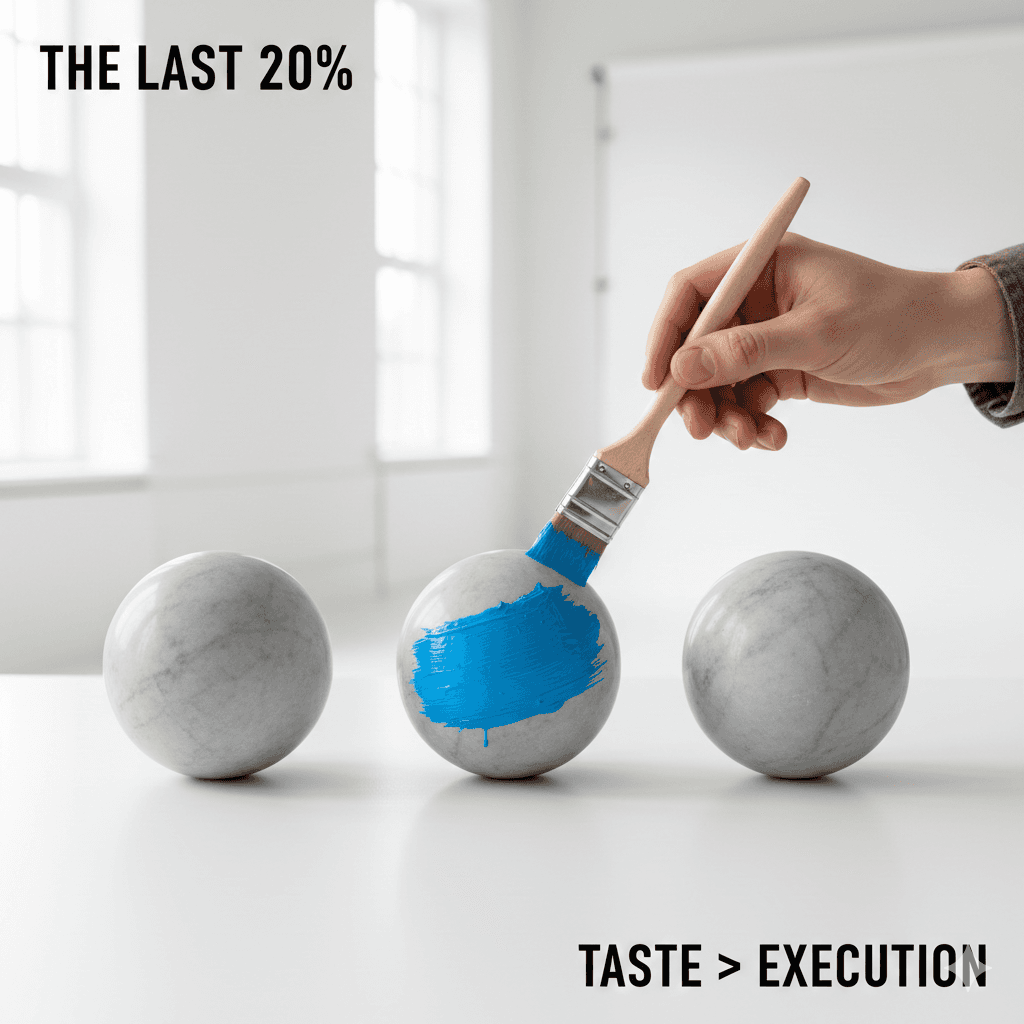
If AI can do 80% of my job for 5% of the cost, what’s the 20% that makes me worth the rest?
For me, it’s:
strategic thinking
taste and judgment
human insight
creative leaps
the ability to explain choices to clients
That’s the part AI can’t touch.
"Hey Siri queue M.C. Hammer - U Can't Touch This"
The Path Forward
Design and communication stay human at their core, but the shape of the work is shifting. The junior designer making social templates is gone. But the designer who understands strategy and uses AI to explore fast is more valuable than ever.
The copywriter making product descriptions is automated. But the strategist who understands psychology and emotion is irreplaceable.
We all have to shift. Not by panicking, but honestly just by developing the right skills and looking a bit more into the overwhelming world of AI, one small piece at a time.
My Question for You
What’s the 20% of your work AI can’t replicate?
And what are you doing this week to strengthen it?
If you’re a designer or communicator, I’d honestly love to hear how you’re adapting.
Reach out to me on LinkedIn