When Clients Become Co-Pilots: My Experience Experimenting With AI While Scaling a Client's Startup
Reimagining healthcare communication through AI
Feb 21, 2026
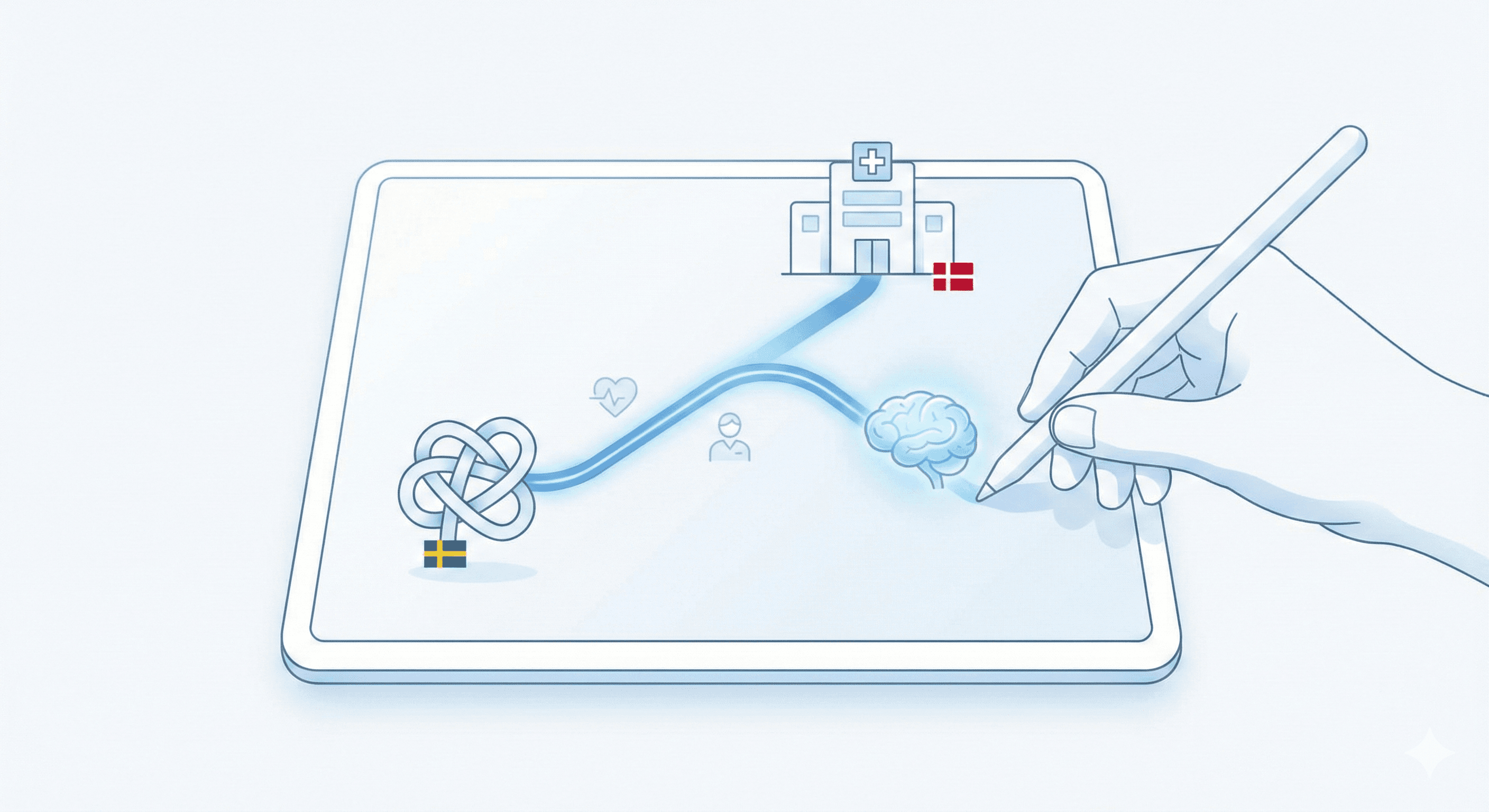
What I've learned about creativity, speed, and judgment after letting AI into my marketing workflow.
I used to think my job was to have good ideas. Now I think my job is to have good ideas faster, test them before a client ever sees them, and show up to every brief already three steps ahead of where I would have been the week before. AI did not change what I do — but it has fundamentally changed how I do it, and what it feels like to do it well.
This is my honest account of what that shift looks like in practice, using my work with a growing Swedish startup as the backdrop.
The Brief That Changed My Workflow
The client is a startup operating in a complex, trust-sensitive space — healthcare navigation. The challenge they handed me was real: build a content and marketing presence from almost nothing, across a website, social channels, and organic search, on a lean budget, for an audience that is simultaneously confused, anxious, and skeptical.
If you have worked with early-stage startups, you know this brief. The founder has a vision. The product is genuinely good. The market exists. But the brand is a blank page, the strategy is scattered, and there is no in-house team to execute anything. You are not just a vendor — you are the marketing department, the creative director, the copywriter, and sometimes the strategist, all at once.
That is where I live. And that is where AI has changed everything.
How I Actually Use AI in My Day-to-Day Work
Let me be specific, because vague claims about AI "boosting productivity" are not useful to anyone.
Strategy and positioning. When I start with a new client, I used to spend days building a positioning document — working through audience segments, competitive landscape, messaging hierarchy, brand voice. I still do all of that thinking. But now I use AI as a sounding board throughout. I will describe the client and their market, then ask it to push back on my assumptions, surface angles I have not considered, or articulate what a skeptical customer would be worried about. The output is never the strategy. But the conversation sharpens my thinking faster than working in isolation does.
Content architecture. Before writing a single word, I map out what content needs to exist: which pages, which topics, which search queries, which formats. AI has become a reliable research partner here. I can describe the audience and the business model and get back a structured content map in minutes — which I then interrogate, edit, and rebuild into something that actually fits the client. What used to take me half a day now takes an hour, and the resulting structure is more thorough because I am critiquing a draft rather than building from scratch.
Drafting and iteration. This is where most people think AI does its work — and they are partly right. I use AI to generate first drafts of articles, landing page copy, social posts, and email sequences. But the drafts are raw material, not finished work. My value is in the editing: knowing what to cut, what to add, what sounds wrong for this brand, what will land with this reader and what will fall flat. The draft gives me something to react to. Reacting is faster and often more generative than starting from nothing.
Visual concepts and creative briefs. This is the area where my workflow has changed most dramatically. I used to write creative briefs for designers in prose — describing the mood, the audience, the message, the visual language I was reaching for. Now I use AI to generate detailed image descriptions, color palette rationales, layout concepts, and even example headlines before I bring in a designer or open a design tool myself. The brief becomes richer. The designer spends less time on revisions. The client sees something closer to right on the first round.
For the startup I have been working with, this meant I could produce visual concepts for social content — hero images, informational graphics, campaign assets — with a level of creative specificity that would have required a full art director conversation in the past. Instead, I could prototype ideas quickly, kill the weak ones myself, and only take the strong ones forward.
The Thing Nobody Talks About: Creative Confidence
There is a psychological dimension to this that I did not anticipate.
When you work alone or with a small team, there is a persistent uncertainty that lives underneath everything: am I missing something obvious? Is this angle actually good, or have I just convinced myself it is? Is the copy landing the way I think it is?
AI does not eliminate that uncertainty — nothing does — but it gives me a way to pressure-test ideas in real time. Before I present a headline to a client, I can run it through a conversation about what different reader segments would make of it. Before I commit to a content strategy, I can describe it in full and ask what the strongest objections would be. Before I write a social ad, I can generate five variations and identify what each one does well and poorly.
This has made me more decisive, not more dependent. I make more confident recommendations to clients because I have already stress-tested them privately. I disagree with AI's suggestions often — but the act of disagreeing is itself useful. It forces me to articulate why my instinct is right, and that articulation usually makes the final output better.
Where I Draw the Line
AI is not a replacement for judgment, taste, or domain knowledge. I have learned this the hard way.
Generic AI output has a texture to it — a particular kind of smooth, plausible competence that reads well on the surface and falls apart when you look closely. It tends toward the middle. It optimizes for not being wrong rather than for being interesting. Left unedited, it produces marketing that is technically correct and emotionally inert — which is the worst possible outcome in a space where trust is the product.
My job is to catch that and fix it. And I can only do that because I understand the client's voice, the audience's anxieties, and the difference between a message that is accurate and one that actually moves someone. That understanding comes from experience and from genuine curiosity about the businesses I work with. AI accelerates the execution of that understanding. It does not replace the understanding itself.
The other hard line is verification. Any factual claim, any specific piece of information that will appear in public-facing content, gets checked against primary sources. AI is confident even when it is wrong, and in high-stakes marketing — where a client's reputation or a customer's decision is on the line — confident and wrong is worse than silent.
What This Means for How I Work With Clients
The most interesting downstream effect of all of this is what it has done to my client relationships.
When I can move faster, test more ideas, and show up to strategy conversations with more developed thinking, clients stop being just briefers and start being genuine collaborators. They are not waiting for me to come back with something. We are building together in real time. The startup I have been working with now regularly sends me a quick voice note about something they have been thinking about, and I can turn that rough idea into a structured proposal, a draft post, or a campaign concept within the same day.
That kind of responsiveness changes the energy of a client relationship. It signals that their ideas matter and have a place to go. It keeps momentum alive in the early stages of a brand, which is exactly when momentum is most fragile and most important.
That is ultimately what I mean when I say clients become co-pilots. It is not about AI. It is about what happens to the collaboration when one person in the room can move fast enough to keep up with how quickly a founder's thinking evolves.
What I Would Tell Someone Starting This Journey
Stop waiting for the perfect workflow and start experimenting with one real project. The value of AI in creative work is not theoretical — it is specific and contextual, and you will not discover your version of it by reading articles about it.
The most important shift is not learning new tools. It is learning to treat AI as a thinking environment rather than a production machine. Use it to question your own assumptions. Use it to generate material you will immediately disagree with. Use it to compress the time between a blank page and a first draft so you can spend more of your energy on the things that actually require you: judgment, taste, empathy, and the ability to tell the difference between what sounds right and what is right.
That is still a human job. It is just a faster, more interesting one than it used to be.
If you want to see all of this live in action, check out the startup here: Vårdagenten